 The Consequences of War is an 1638 painting complete by artist Paul Rubens. The message of this painting is exceptionally pessimistic: even love cannot restrain the brutality of the Thirty Years War from plunging Europe into mourning and destroying her prosperity. This did not prevent Rubens portraying this tragic subject in the most Titianesque spirit, as a perfect demonstration of chromatic harmony.
Thursday, December 2, 2010
Rubens Consequences of War
The Consequences of War is an 1638 painting complete by artist Paul Rubens. The message of this painting is exceptionally pessimistic: even love cannot restrain the brutality of the Thirty Years War from plunging Europe into mourning and destroying her prosperity. This did not prevent Rubens portraying this tragic subject in the most Titianesque spirit, as a perfect demonstration of chromatic harmony.

Uccello Battle of San Romano
 The Battle San Romano is a set of three painting by Paolo Uccello, a Florentine painter. The set depicts the events that occured at the battle of San Romano in 1432. The paintings were in tempera on wooden panels, and were much admired in the 15th century. They are now divided between three collections.
Column of Trajan
 Trajan's Column is a triumphal column in Rome, Italy. It commemorates the Roman emperor Trajan's victories in the Dacian Wars and was constructed at the order of the Roman Senate. It was complete in 113 BE and is most famous for its spiral bas relief. It artistically describes the epic wars between the Romand and the Dacians. It design has inspired both ancient and modern victory columns. It is almost 100 feet tall.
Arch of Titus

 The Arch of Titus is an honorific arch created in the first century. It is located on the Via Sacra in Rome and was constructed in 82 CE by the Roman Emperor Domitian after the death of his brother Titus. It commemorates Titus' victories. This arch provided the model for many of the triumphal arches erected, most famously the 1806 Arc de Triomphe in Paris.
Ara Pacis
 The Ara Pacis Augustae (of the Altar of Augustan Peace) is an altar to Peace, envisioned as a Roman goddess. It was commissioned by the Roman Senate in 13 BCE to honor the triumphal return of Augustus from Hispania and Gaul. It was consecrated in 9 BCE by the Seante to celebrate the peace established in the Empire by Augustus. The altar was meant to be a vision of the Roman civil religion.
Parthenon
 The Parthenon is a temple in Athens, Greece. The people of Athens dedicated this temple to the Greek goddess Athena. It was created in the 5th century BCE, started shortly after the Battle of Marathon. It was constructed on top of a limestone foundation that extended and leveled part of the Acropolis summit. The Parthenon's facade can be described as the golden rectangles, but this has been disputed in recent studies.
Mapplethorpe Piss Christ
 Piss Christ is a photograph from 1987 by Andres Serrano. It shows a small plastic crucifix submerged in a glass of the artist's own urine. The photograph was one of a series of photographs that Serrano had made that involved classical statuettes submerged in various fluids (like blood, milk, and obviously, urine). Without a given explanation, the viewer would not necessarily be able to tell the difference between urine or another similar medium, like amber.
Serrano said that the work itself is not intended to denounce religion. It alludes to the commercialization and cheapening of Christian icons in contemporary culture.
Dali The Last Supper
 Dali once said that "communion must be symmetric." That is seen clearly in his rendition of the last supper. It was painting with oil on canvas in 1955. Much like the da Vinci painting, Christ is sitting centrally at the table with the disciplines around him. In the background, windows look on to a landscape. Christ himself is almost transparent, with the arms and chest of a man above him in the sky. This suggest that he was already ascending to heaven.
Rubens Elevation of the Cross
 The Elevation of the Cross is a triptych painting by the Flemish artist Peter Paul Rubens. It was complete in 1610-11. He painted it after returning to Flanders from Italy. The work shows a clear impression from the Italian Renaissance and Baroque artists like Michelangelo. The middle panel (shown in the image to the left) show the tension between the multitude of finely muscled men trying to lift the cross and the almost unbearable wright of Christ.
Wednesday, December 1, 2010
Caravaggio Conversion of St. Paul
 The Conversion of Saint Paul was created by the Italian painter Caravaggio. It is housed in Rome. It was commissioned by Tiberio Cerasi, the treasurer to the Pope, in September 1600. Both of the painting were rejected by Cerasi and replaced by the second versions which hang in the chapel today. There is a lot of motion and action in this painting.
I really like the horse's flanks.
Bosch Garden of Earthly Delights
 The Garden of Earthly Delights is a triptych painted by Hieronymus Bosch. It was housed in the Museo del Prado in Madrid since 1939. It is his best known and most ambitious work. It reveals the artist at the height of his powers. He never again achieves such complexity of meaning or such vivid imagery. The outer wings display a grisalle painting of the earth during Creation. Art historians and critics frequently interpret the painting as a didactic warning on the perils of life's temptations.
Grunewald Isenheim Altarpiece
 The Isenheim Altarpiece is an altarpiece painting by the German artist Matthias Grunewald started in 1506 and completed in 1515. It is on display at the Unterlinden Museum in France. Often called his greatest work, the Isenheim Altarpiece is by far his largest. It was painted for a Monastery. The monks of the Monastery were noted for their treatment of suffers of skin disease. Such symptoms are displayed by figures including the crucified Christ in the altarpiece.
Parmigianino Madonna with Long Neck
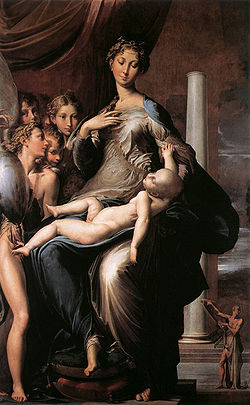 Madonna with the Long Neck is an Italian Mannerist oil painting by the Italian painter Parmigianino in 1535. It depicts Modonna and child with angels. Parmigianino started the painting in 1534 for the church. It remained incomplete on Parmigianino's death in 1540. It was purchased in 1798.
Christianity: the first two thousand years
 I have to be honest. We did not finish the second disc because the DVD was only on a three hour reserve. The first disc tells the story of Christianity form the death of Jesus to the standoff between Pope Gregory VII and the Holy Roman Emperor Henry IV who had authority to appoint bishops. My favorite section of this was was the portion on the Byzantine Empire, because I'm going to CONSTANTINOPLE. I'm so excited!
The second DVD begins where the last one ended, with a 20 minute review of what was on the first disc. I liked the part about the reformation because it helped me clear lots of facts up in my head. The last time I learned about the reformation was in AP world history in 10th grade, so it's been a while.
I really enjoyed the diversity of the people that were interviewed during the film. They had scholars that spanned from Stuart of Gordon Conwell and Justo Gonzales to the head of the Jesus Seminar. There were both male and female scholars, popular writers and religious professions in every imaginable coustine.
Engineering an Empire: The Persians
This film followed the rise and fall of the Persian Empire from 580 BCE to 320 BCE. I did not like how there wasn't much about the glory that was Persian. I feel like contemporary politics has bled into our understanding of history. But there was a time about 2500 years ago when Persia was IT in the Middle East. The episode deals mainly with Cyrus and Darius, but doesn't focus on the scientific discoveries that came out of the time period.
The episode instead dwells on technologically feats (like bringing water form the mountain to the city using underground tunnels. This provided both a constant water supply for the large city and splendid gardens. The gardens provided the template for modern parks.
The Perisan Empire was an impressive empire. I wish I could have lived there. As a wealthy aristocrat, of course, not as a common laborer. And probably not as a women either. So, I think I changed my mind.
I'm quite content here: in modern times.
The episode instead dwells on technologically feats (like bringing water form the mountain to the city using underground tunnels. This provided both a constant water supply for the large city and splendid gardens. The gardens provided the template for modern parks.
The Perisan Empire was an impressive empire. I wish I could have lived there. As a wealthy aristocrat, of course, not as a common laborer. And probably not as a women either. So, I think I changed my mind.
I'm quite content here: in modern times.
Who wrote the Bible? Volume 1 and 2
Who wrote the bible is a very good scientific investigation on Biblical mysteries I have ever seen. I really enjoyed the two and a half hours that I spent on a rainy day in the library learning from such an informative source of documentary footage. It was quite educating, and it fully satisfied my curiosity.
I think that it was probably really hard to make such a special that did not sway to the right or to the left (propaganda wise). I think they did a very good job. It was very informative and balanced.
However, the video did make a very good point at the end. It is not important who wrote the bible, but know and understand what the bible offers. If the bible can make a difference in your life, the bible did what Jesus has been telling us for centuries.
I think that it was probably really hard to make such a special that did not sway to the right or to the left (propaganda wise). I think they did a very good job. It was very informative and balanced.
However, the video did make a very good point at the end. It is not important who wrote the bible, but know and understand what the bible offers. If the bible can make a difference in your life, the bible did what Jesus has been telling us for centuries.
Digging for the Truth: Stonehenge Secrets Revealed
Stonehenge is one of the most famous and mysterious structures in the world. Josh Bernstein investigated the origins of Stonehenge and the prehistoric world that surrounded it. From the depths of a 5,000-year-old copper mine to an ancient quarry from which the stones were carved, Josh deployed the latest archaeological evidence to reveal who built this great monument.
Stonehenge has many mysteries. How were these stones moved? is one of them. We know they moved the stones. There is no shortage of theories to explain how they got there. Kind of like the pyramids. Archaeologists have found tracks perfectly preserved in some of the UK's peat bogs. These tracks could have been built for the express purpose of moving stones across the countryside. The people on the show put the theory to the test and, indeed, with a wooden sled on wooden track, the stones were surprising easy to move.
The film itself was made with humor and in good fun, making it more fun to watch than a few of the others. I liked that they actually tried the theories, instead of just talking about them.
Stonehenge has many mysteries. How were these stones moved? is one of them. We know they moved the stones. There is no shortage of theories to explain how they got there. Kind of like the pyramids. Archaeologists have found tracks perfectly preserved in some of the UK's peat bogs. These tracks could have been built for the express purpose of moving stones across the countryside. The people on the show put the theory to the test and, indeed, with a wooden sled on wooden track, the stones were surprising easy to move.
The film itself was made with humor and in good fun, making it more fun to watch than a few of the others. I liked that they actually tried the theories, instead of just talking about them.
The First Olympics
 The First Olympics visits the ruins of ancient Olympia. Both the Bacchanalian excess and raw competition were shown here. While the gods looked down, brutal contests of boxing, wrestling, chariot racing and an early form of no-holds-barred fighting raged within the bloodied arena.
The First Olympics were a series of athletic competition held for various city-states in honor of Zues. Records show them beginning in 776 BCE in Olympia in Greece. Theodosius I suppressed the Olympics in 393 CE as part of a campaign to impose Christianity as a state religion. The games were held every four years. During the games, an Olympic truce was enacted so that athletes could travel from their countries to the Games in safety. The prizes were olive wreaths or crowns.
I think it is neat that this film was produced in honor of the Athens 2004 Olympic Games. It is surprising how similar the ancient olympic games were to the modern olympics. We gather together to honor world unity, just like they gathered together to honor unity behind Zues. I am, however, glad that we wear clothes now.
Tuesday, November 30, 2010
Sistine Chapel
 The Sistine Chapel is the best-known chapel in the Apostolic Palace (the residence of the Pope). It is famous for its architecture and is decoration. It has been frescoed throughout by the greatest artists of the Renaissance artists: Michelangelo, Raphael, Bernini, and Sandro Botticelli. Michelangelo painted 12,000 square feet of the chapel ceiling between 1508 and 1512. He resented the commission, believing his work only served the Pope's need for grandeur. Today the ceiling is widely believed to be Michelangelo's crowing achievement in painting.
Pieta
 Pieta is a masterpiece of Renaissance sculpture by the artist Michelangelo Buonarroti. It is housed in St. Peter's Basilic. It is the first of a number of works of the same theme by the arits. It was commissioned by a French cardinal who was a representative in Rome. The work depicts the body of Jesus on the lap of Mary after the crucifixtion. Michelangelo's intepretation is unique. It is an important work because it balances Renaissance ideals of classical beauty with naturalism.
Last Supper
 The Last Supper was the last meal Jesus shared with his 12 Apostles and disciples before his death. The Last Supper has been the subject of many paintings of which that by da Vinci is perhaps best known. It was painted for his patron Duke Ludovico Sforza and his duchess Beatrice d'Este. This painting is 15 feet by 29 feet. The Last Supper specifically portrays the reaction given by each apostle when Jesus said one of them would betray him.
The da Vinci code might be historically inacurate, but it's a pretty awsome book.
Leonardo Madonna of the Rocks
 The Madonna is sitting with Christ child and St. John the Baptist as a child, with a beautiful angel complete with wings. I really like the rock formations in the background. They are really interesting. They are several examples of phallic symbolism. At the top right of the painting is a peculiar rock formation forming the "V" symbol. There are two different versions of the painting, one in the Lourve and one in the National Gallery of Art in London.
Foreshortened Christ
 The Lamentation over the Dead Christ is a painted complete around 1480 by the Italian Renaissance artist Andrea Mantegna. The dating of the piece is debated. It portrays the body Christ on a marble slab. He is watch over by the Virgin Mary and St. John, who are crying over his demise. The theme of this painting is common in this period.
Basilica of Santa Maria Novella
 Santa Maria Novella is a church in Florence, Italy. It is across from the main railway station which shares its name. Chronologically, it is the first great basilica in Florence. The church was called new because it was built on the site of the 9th-century oratory of Santa Maria delle Vigne. The church was designed by two Dominican friars. Construction began in the mid-13th century and was finished around 1360.
The Holy Trinity
 The Holy Trinity is a fresco by the Early Italian Renaissance painter Masaccio. It is located in the Dominican church of Santa Maria Novella, in Florence. Several diverse interpretations of the fresco have been proposed. Most seen it as a traditional kind of image, intended for personal devotions and commemorations of the dead. The iconography of the Trinity is not uncommon in the period of art. Carved in the wall above the skeleton is an inscription: I once was what you are and what I am you also will be.
Tribute Money
 The Tribute Money is a fresco by the Italian renaissance painter Masaccio. It is located in the Brancacci Chapel of the basilica of Santa Maria del Carmine in Florence. It was painted in the 1420s and is widely considered Massaccio's best work. It is a part of a cycle on the life of Saint Peter and describes a scene from Matthew. Masaccio is often compared to contemporaries like Donatella as a pioneer of the renaissance. His use of light was also revolutionary.
Ghiberti Gates of Paradise
 Born in Florentine and trained by a goldsmith, Lorenzo Ghiberti won the second competition in 1403 for a commission to create gilded bronze doors for the east side of the Baptistery of Florence Cathedral. The door project look Ghiberti 20 years to complete. In the 20 panels of The Gates of Paradise, Ghiberti made a complete transition from the outdated Gothic style with its swirling draperies to the Renaissance style in panels which contain naturalistic figures.
Donatello St. Mark
 Donatello's Saint Mark is a marble statue that is 7'9'' and sits in an exterior niche of the Orsanmichele church in Florence. Donatello was commissioned by a guild of linen weaver to complete three pieces for the project. St. Mark was the first. A copy of the statue stands in the original's place, while the real St. Mark is housed inside the church's museum. St. Mark is notable for its detailed realism, which provides evidence of the artist's skills.
Jean Fouquet Melun Diptych
 Melun Diptych was created by Jean Fouquet and was completed in 1450. One wing hangs in the Royal Museum of Fine Arts in Belgium and the other in Berlin. The name of the diptych came from its original home in the Melun cathedral. The right wing shows the virgin and child surrounded by angels. The model for the Virgin was King Charles VII's mistress at the time, Agnes Sorel.
Campin Merode Altarpiece
 The Merode Altarpiece is a triptych (hinged three part panel) by the early Netherlandish painter Robert Campin. It was created between 1425 and 1428 and has become Campin's greatest work. This was helped by the undoubted charm of the domestic setting and townscape outside the windows.
Milan Cathedral
 Milan Cathedral is the cathedral church of Milan in Lombardy, northern Italy. It was dedicated to Santa Maria Nascente and is the seat of the Archbishop of Milan. The cathedral took five centuries to complete. It is the largest Gothic cathedral and the second larges Catholic cathedral in the world. The work began in 1386 and was complete in 1965. The roof, which is renowned for the forest of openwork pinnacles and spires, is open to to tourists.
Cambio Florence Cathderal
 The Basilica di Santa Maria del Fiore is the cathedral church of Florence, Italy. This began in 1296 in the Gothic style to the design of Arnolfo di Cambio and complete structed structurally in 1436 with the dome engineered by Filippo Brunellschi. It is a major tourist attraction to people visiting the region of Tuscany. The dome is the largest brick dome every constructed.
Giotto Lamentations
 The lamentation of Christ is a very common subject in Christian art from the High Middle Ages to the Baroque. After Jesus was crucified, his body was removed from the cross and his friends and family mourned over his body. This even has been been depicted by many different artists.
Sainte-Chapelle
 La Sainte-Chapelle, The Holy Chapel, is a Gothic chapel in the heart of Paris, France. It is regarded as the high point of the Rayonnant period of Gothic architecture. The Rayonnant style achieved a sense of weightlessness. The Chapel was sponsored by King Louis IX and was completed in 1248. It was designed with the Hagia Sophia in mind. Just as the Emperor could pass privately from his palace into the Hagia Sophia in Constantinople, so now could Louis pass directly from his palace into the Sainte-Chapelle.
Notre Dame
 Notre Dame (Our Lady) de Paris is a Gothic, Catholic cathedral in Paris, France. It is the church that contains the official chair of the Archbishop of Paris. Notre Dams is widely considered one of the finest examples of French Gothic architecture in France and Europe. It was restored and saved from destruction by Eugene Viollet-le-Duc, one of the most famous architects of France. Notre Dam was among the first buildings in the world to use the flying buttresses. The building was designed have have flying buttresses but they were necessary after stress fractures began to occur on the high outside walls.
Chartres Cathedral
 The medieval Cathedral of Our Lady of Chartes is a Latin Rite Catholic cathedral located in Chartes, which is about 50 miles southwest of Paris. It is considered one of the finest examples of the French High Gothic style. The current cathedral, the forth that has occupied the space since the 4th century, was constructed between 1193 and 1250. It has been preseved exceptionally. The majority of the original stained glass windows survive intact, and only minor changes have occured since the early 13th century. The exterior of Chartes is dominated by heavy flying buttresses which allow the architects to increase the size of the windows significantly. The west end has two contrasting spires.
Friday, November 26, 2010
Saint Denis
 Saint Denis is a large abbey church in the northern suburbs of Paris. It is about 6 miles form the center of Paris. The building is unique. It was founded in the 7th century on the burial of Saint Denis. It became a place of pilgrimage and the burial place of many French kings. It was the first major structure of which a substantial part was designed and built in the Gothic style.
Baptistery of San Giovanni, Florence
 The Baptistery of Florence is octagonal and is one of the oldest buildings in the city. It was build between 1059 and 1128. The architecture is in Florentine Romanesque style. The Baptistery is renowned for its three sets of artistically important bronze doors and their relief sculptures. The east pair of doors was dubbed "the Gates of Paradise" by Michelangelo. Many notable Renaissance figures were baptized in this baptistery. In fact, until the end of the nineteenth century, all Catholic Florentines were.
Giselbertus Last Judgment
 The Last Judgment has at its center Christ enthroned in a gloriole held by angels. Each of the sides is split into two registers with the architrave underneath. The upper shows the enthroned Virgin Mary and two apostles as observers of the judgment. In the lower, to the right of Christ, eight apostles stand facing the enthroned figure. They look like petitioners. St. Peter is gaurding the entrance.
Saint-Sernin
 The Basilica of St. Sernin is a church in France. It was built in the Romanesque style between 1080 and 1120. Despite being called a basilica, St. Sernin's deviates from the basilica plan. It is much larger than earlier churches and the ceilings are also vaulted. There is also an ambulatory, a walkway that goes around the nave and side aisles to allow for viewing of the radiating chapels. The bell tower is the most visible feature. It is divided into five tiers. The lower three tiers date from the 12th century and the upper two from the 14th.
Thursday, November 18, 2010

Lindau Gospels
 The Lindau Gospel Book Cover is a representative of the 9th century due to its quality to compel and garner admiration form the common masses. The majority of the citizens that lived during this time would not read. The works of art on the book cover function as a metaphor for the story contained within them.
Chi-rho-iota Page Book of Kells
 This is the Chi Rho Monogram Page from the Book of Kells. It is from the late 8th century. It survived the Viking raids of 804 on the island of Iona and was then carried off to Kells. The initial letters of Christ in Greek are what are printed on the page: chi-rho-i
Beta Giorghis, Lalibela
 First impression: freaking awesome. The Church of St. George in Ethiopia was built in the thirteenth century. It is often referred to as the "eighth wonder of the world." The church itself is carved out of solid rock. It is said that the churches in Labibela were build with amazing speed and until this day people still believe that angels came at night and helped finish them.
Thursday, November 11, 2010
Alhambra
 Alhambra is a palace completed in the 14th century by the Moorish rulers of Spain. There was no master plan for the total design of the site, so the layout is not organized. The decorations within the palaces exemplify the remains of Moorish dominion within Spain. The isolation from the rest of Islam plus the commercial and political relationship with the Christian kingdoms also influenced building styles.
Malwiya Minaret, Iraq
 The Malwiya Minaret is part of the Great Mosque in Samarra, Iraw. It is one of the largest mosques in the world. The minaret itself was originally connected to the mosque by a bridge. The tower was constructed in 848-852 out of sandstone. It is unique because of its spiral, conical design. The spiral contains stairs reaching to the top. The word malwiya means snail shell. The height of the minaret made it impractical for the general purpose of a minaret, the call to prayer.
Great Mosque Damascus
 The Great Mosque of Damascus is one of the largest and oldest mosques in the world. It is number four on the list of holiest places in Islam. The mosque was built on the Christian basilica to John the Baptist after the Arab conquest of Damascus. The minaret in the southeast corner is called the Minaret of Jesus because many Muslims believe that it is here that Jesus will appear.
Dome of the Rock
 The Dome of the Rock is an Islamic shrine located in Jerusalem. The rock is known as the Foundation Stone. The significance of the site stems from the religious beliefs revolving the rock. The Dome of the Rock was complete around 691 CE. The Dome of the Rock was intended to compete with the other fine buildings of worship of other religions in the city. The dome, although at that time foreign to Islam, attempted to rival the many domes of Christian churches in the city. The structure of the building itself is octagonal.
Hagia Sophia
 The Hagia Sophia is a former Orthodox basilica, later a mosque, and now a museum in Istanbul, Turkey.
Cathedral: 360-1453
Roman Catholic Cathedral: 1204-1261
Mosque: 1453-1934
Famous for its massive dome, it is considered the epitome of Byzantine architecture and is said to have changed the history of architecture. It was the largest in the world until Seville Cathedral was complete in 1520. It is the church in which the Great Schism of Christianity started in 1054.
The Hagia Sophia later served as a model for other Ottoman mosques, such as the famous Blue Mosque of Istanbul.
Interior of S. Costanza
 Santa Costanza is a church in Rome built under Emperor Constantine. It is the place of burial of his daughters Constantina and Helena. Later, Constantina was venerated as a saint, with the Italian name of Costanza, and the church was dedicated to her. What remains of the interior of the building is decorated ornately with mosaics which hint at a rich patronage of pagan and Christian provenance. The ceiling is vaulted and decorated with mosaics which recall classic themes of early Christian beliefs.
Interior of S. Sabina
 The Basilica of Saint Sabina at the Aventine is a titular minor basilica in Rome, Italy. Saint Sabina is an early 5th century basilica with a classical rectangular plan and columns. Saint Sabina has an airy and roomy interior because the light that pours in through the windows. The mosaic was the original interior, but it was replaced in 1559 by a similar fresco by Taddeo Zuccari. The composition remained unchanged. In the painting, Christ is flanked by male and female saints, seated on a white hill while lambs drink from a small stream at its base.
Tuesday, November 9, 2010
Junius Bassus, Sacrophagus
 The Sarcophagus of Junius Bassus is a sarcophagus used for the burial of Junius Bassus, who died in 359. It is often described as the most famous piece of early Christian relief sculpture. The sarcophagus was placed under Old St. Peter's Basilica and was rediscovered in 1597. It is now behind the modern basilica. It combines the Old and the New Testament characters.
Subscribe to:
Posts (Atom)