 Jean Tinguely was born on March 22, 1925, in Switzerland. He is best known for his sculptural machines or kinetic art, known as metamechanics. Tinguely's art satirized the mindless overproduction of material goods in advanced industrial society. His best-known structure is title Homage to New York and is partially self-destructed at the Museum of Modern Art in New York City.
Monday, December 6, 2010
Tinguely Homage to New York
Jean Tinguely was born on March 22, 1925, in Switzerland. He is best known for his sculptural machines or kinetic art, known as metamechanics. Tinguely's art satirized the mindless overproduction of material goods in advanced industrial society. His best-known structure is title Homage to New York and is partially self-destructed at the Museum of Modern Art in New York City.

Chagall I and the Village
 I like nice looking things and I like well written things. So I decided to combine the two here. Chagall painting I and the Village is very abstract. It shows a quaint French village and a person looking on. I don't exactly know what the other thing is (a sheep perhaps), but I love the scene. This is what someone said about Chagall experience in Paris:
Chagall was exhilarated, intoxicated, as he strolled through the streets and along the banks of the Seine. Everything about the French capital excited him: the shops, the smell of fresh bread in the morning, the markets with their fresh fruit and vegetables, the wide boulevards, the cafe′s and restaurants, and above all the Eiffel Tower.
I think the painting and that paragraph go very well together. A nice pair.
Klee Twittering Machine
 I can't help but love the original German title: Die Zwitschermaschine. German is such a harsh, long winded language. Die Zwitschermaschine is the 1922 work of Paul Klee. It can be seen at the Museum of Modern Art in New York City. Paul Klee was also a poet. I really like this painting, even though I am not quite sure what it is. I feel like I could have a print of it on my wall for about 25 years and then maybe have some sort of an idea of what is going on. This is the type of art that I like. The art that gets you thinking.
Dali The Persistence of Memory
 The Persistence of Memory is a 1931 painting by Salvador Dali. It is one of his most recognizable works. The painting has been on display at the Museum of Modern Art in New York City since 1934. As Dawn Ades wrote, "The soft watches are an unconscious symbol of the relativity of space and time, a Surrealist meditation on the collapse of our notions of a fixed cosmic order." The orange clock at the bottom left of the painting is covered in ants. Dali often used ants in his paintings as a symbol for death, as well as a symbol of female genitalia.
This painting has a special meaning for me. My grandmother's coffee table book has this on the cover. The book itself is a book on Dali that is written in Spanish. So, I never could actually read the words, but I was often caught staring; perplexed at the melting clocks. I didn't even know the title of the work until just now. Wherever she moved, the same book with the same painting was on the same table.
Persistent memory? I think so.
Ernst Two Children are Threatened
 Two Children are Threatened by a Nightingale is a 1924 painting of Max Ernst. It is oil on wood with wooden elements and can be found on display in the Museum of Modern Arts in New York City. Its title can be found, in French, on the front. This adds emotion and causes anticipation of the possible horror ahead. The viewer is more frightened or threatened than the children are, as the nightingale is a harmless bird soaring in the distance. Ernst created radically different artwork than was popular before his time. He became a pioneer of dada and surrealist art.
De Chirico The Mystery and Melancholy of a Street
 The Mystery and Melancholy of the Street was completed in 1914 by Giorgio de Chirico. It is oil on canvas. We talked about this image in class. I think it is very interesting. The girl in the foreground, playing, is not actually real, she is just shadow. The shadow coming from the square is quite scary. The evening sun has cast the shadow in a very long way. The colors also create an ominous feeling. Yellow is a color of fear and the color of the sky is not entirely normal, for when are skies green? As the title says, the entire painting is quite mysterious.
Grosz Fit for Active Service
 Fit for Active Service is a drawing by the 20th century German artist George Grosz. It was created between the years 1916 and 1917. It is considered a seminal part of the post-World War I movement. It depicts a dead skeleton being judged as physically fit for conscription. All of the German doctors around him have looks of indifference or smiles on their faces. There are also smokestacks in the background windows. This is symbolic of the social disillusion of rapid industrialization and urbanization.
Grosz himself initially avoided conscription, but was deemed fit in 1917. He was discharged after attempting suicide.
Grosz on his war experience:
Of course, there was a kind of mass enthusiasm at the start. But this intoxication soon evaporated, leaving a huge vacuum... And then after a few years when everything bogged down, when we were defeated, when everything went to pieces, all that remained at least for me and most of my friends, were disgust and horror.
Hoch Cut With the Kitchen Knife
 Hoch is recognized as a pioneer of photomontage. This photomontage was crafted from images and text printed in German newspapers. This collage protests high culture by recontextualizing found images and framing them in a different way. It can also be called anti-art. One male figure in the collage appears to be wearing a skirt. Another has a donkey resting on the top of his head.
Duchamp Fountain
 I thought that I would just insert the essay that I wrote on Duchamp for French class two semesters ago. It sheds a little light on my lack of art education (that has now been partially fulfilled):
When Dr. Dalia began speaking, I was immediately captivated by her interesting accent and genuine excitement about Marcel Duchamp. Her accent sounded kind of French, but not exactly. Eventually, she informed the audience that her first language was Hungarian. This alleviated my intense curiosity. Also, Dr. Dalia excitement about Duchamp was entirely genuine. This genuine and earnest excitement about learning was something that I was introduced to by my parents, but rarely collided with in my education before I got to Oglethorpe. Here, I get to see my professors truly excited about their subject matter. I think it is because they are still learning, unlike many middle and high school teachers.
Dr. Dalia’s speech about Duchamp was my first real introduction to Art History. As a history major, one might find that fact surprising, but I attended a rural high school in South Georgia, where football is more highly valued than education. I was incredibly interested in the concept of the viewer’s involvement in art. It is interesting to think that one person could change the direction of an entire field so dramatically.
Dr. Dalia said one additional fact that I believe it is important to mention. She said that the last institution to the affected by the recent economic crisis was art. So, DO NOT invest in real estate, invest in art instead.
Jean Arp Collage
 This piece was completed in 1916-1917. Arp claimed that in making this work, he tore pieces of paper and allowed them to remain where they fell, creating a composition more on chance than on his conscious control. People say that in some of the pieces you can see glue from where he moved the paper, so they call his works "assisted chance."
I like the sound of that. I need some assisted chance in my life.
Picasso Three Musicians
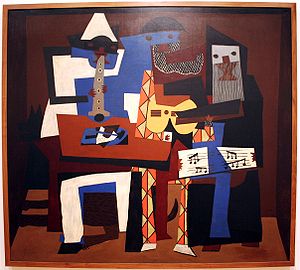 Three Musicians is the title of two collage and oil painting by Pablo Picasso. They were both completed in 1921. They exemplify the Synthetic Cubist style. One is owned by the Museum of Modern Art in New York City. Each painting shows a Harlequin, a Pierrot, and a Monk. There is also a dog laying behind the musicians.
In class one day, someone played the Clarinet while we all stared at this painting. I thought it was quite a nice class period.
Delaunay The Red Tower
 Robert Delauny's 1911-1912 painting The Red Tower is a unique view of the Eiffel Tower. Robert Delaunay was a Cubist painter born in Paris, though he also worked in Abstract and Impressionistic styles. Delaunay would often use the Eiffel Tower as a theme in his work, a trademark that he became known for. During his lifetime, Delaunay created not only oil paintings and costume design, but murals, decoration and even architectural designs for the 1937 Worlds Fair. Delaunay also left behind numerous sketches. He is an influence for many Abstract artists.
Kandinsky Improvisation 28
 Vasily Kandinsky's Improvisation 28 is an oil painting completed in 1912. It is in the Solomon R. Guggenheim Museum in New York City. Kandinsky went on a crusade against conventional aesthetic values of his dream of a better, more spiritual future through the transformative powers of art.
I'm not exactly sure that is going on in this painting. It looks like it is in a city (because of the spires).
Kachina dools
 Kachinas are stylized religious icons carved from cottonwood root and painted to represent figures from the mythology of the Hopi. These "dolls" have been used for generations to teach children about their religion. Hopi children have never taken a Kachina to bed. They dolls are made ONLY by Hopi artists.
Klimt The Kiss
 The Kiss was painted by Gustav Klimt and is his most famous work. When The Kiss was painted Klimt was 45 and lived at home with his mom and two unmarried sisters. Some say that he was a man with a "ferocious sexual appetite." He was supposedly obsessed by women, especially redheads. The focus of the painting is a couple locked in embrace. The rest of the painting is shimmering, extravagant flat pattering.
Munch The Scream
 The Scream shows an agonized figure against a blood red sky. It was completed in 1893 by Edvard Munch. The enviornment of The Scream is often compared to that of which an individual suffering from Depersonalization disorder experiences, such as a feeling of distortion of the environment and one's self.
In a page in his diary, Munch described his inspiration for the image thus:
I was walking along a path with two friends — the sun was setting — suddenly the sky turned blood red — I paused, feeling exhausted, and leaned on the fence — there was blood and tongues of fire above the blue-black fjord and the city — my friends walked on, and I stood there trembling with anxiety — and I sensed an infinite scream passing through nature.
Rousseau Sleeping Gypsy

 The Sleeping Gypsy is an oil painting by French artist Henri Rousseau. It was completed in 1897 and is one of the most recognizable pieces of modern times. Rousseau actually tried unsuccessfully to sell the painting to the mayor of his hometown. It depicts a lion musing over a sleeping woman on a moonlit night. It is depicted often in popular culture.
Redon The Cyclps
 Redon describes his work as ambiguous and undefinable:
"My drawings inspire, and are not to be defined. They place us, as does music, in the ambiguous realm of the undetermined."
I'm not doing to define it.
But I am inspired, so Redon did his job.
Such a cute little cyclops.

Moreau Jupiter and Semele
 Moreau on abstraction:
"I am dominated by one thing, an irresistible, burning attraction towards the abstract. The expression of human feelings and the passions of man certainly interest me deeply, but I am less concerned with expressing the motions of the soul and mind than to render visible, so to speak, the inner flashes of intuition which have something divine in their apparent insignificance and reveal magic, even divine horizons, when they are transposed into the marvellous effects of pure plastic art."
I think this is an awesome painting (in the true, not popular, definition of awesome). The romantic woman lying across the lap of the aztec-like king truly identifies with his words on the abstract.
Van Gogh Night Café
 The Night Cafe is an oil painting created in Arles in September 1888, by Vincent van Gogh. The cafe itself really existed: it was run by Joseph-Michel and his wife Marie Ginoux.
In a letter to his brother, van Gogh says,
Today I am probably going to begin on the interior of the café where I have a room, by gas light, in the evening. It is what they call here a “café de nuit” (they are fairly frequent here), staying open all night. “Night prowlers” can take refuge there when they have no money to pay for a lodging, or are too drunk to be taken in.
Subscribe to:
Posts (Atom)